


The life of Jews in the city of Pécs was not always easy. Although individual Jewish families lived in the area even before the Turkish invasions, public expression of non-Muslim faiths was heavily restricted during the Ottoman Empire. It was only in the 18th century — and especially in the 19th century — that the community began to grow more rapidly.
Gradually, the number of Jews in the city increased significantly. They were active in trade, crafts, banking, and industry, making an important contribution to the economic development of Pécs. As the community expanded, the need for a representative synagogue became evident.
The Pécs Synagogue (Pécsi zsinagóga) is today one of the most beautiful synagogues in Hungary and an important monument to the history of the Jewish community that left a deep mark on the city. When you visit the synagogue in Pécs today, you stand before a building that is not only an architectural landmark, but also a symbol of resilience and cultural diversity.
An Architectural Work by Frigyes Feszl
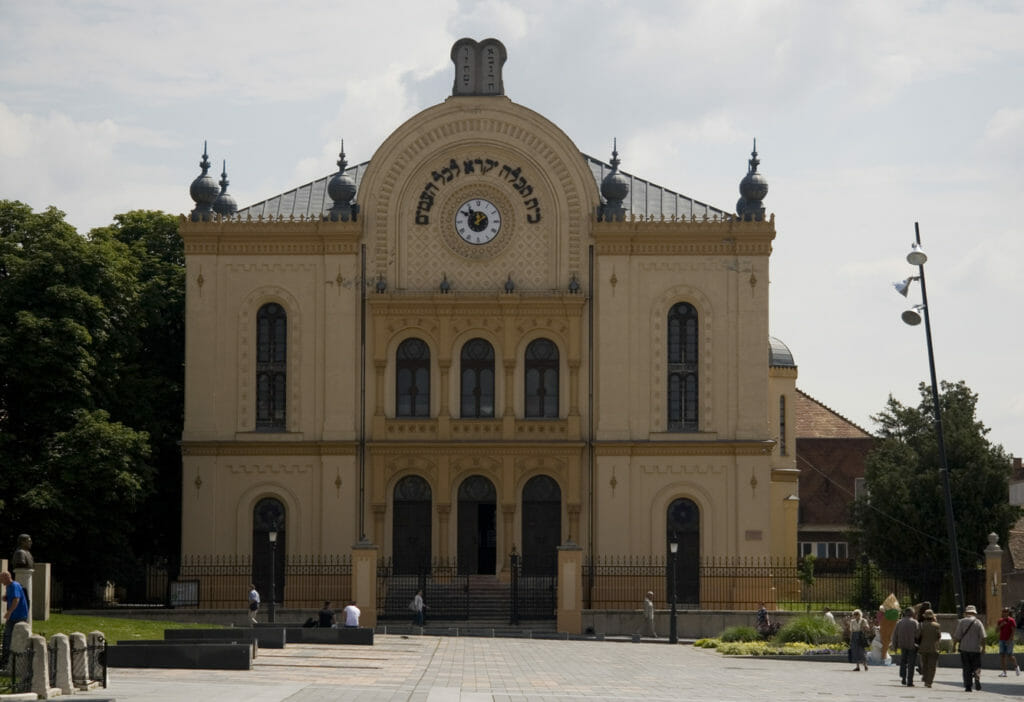
The present synagogue was built in 1869 according to the plans of the renowned Hungarian architect Frigyes Feszl, who also contributed to the design of the famous Vigadó Concert Hall in Budapest. His style combines elements of Romanticism and Moorish Revival, both of which were popular in synagogue architecture across Central Europe at the time.
One of the distinctive features of the Pécs Synagogue is its symbolic emphasis on the number three. The façade is divided into three sections, and the interior follows the same tripartite structure. The central nave is also divided into three parts, and a gallery (balcony) runs around the main prayer hall.
At the top of the building, a clock is surrounded by a Hebrew inscription:
“My house shall be called a house of prayer for all peoples.”
This verse emphasizes the openness and universal message of the space — the synagogue as a place of prayer, peace, and community.
Interior: Elegance and Acoustics
The interior of the Pécs Synagogue impresses visitors with its rich yet balanced decoration. High arches, subtle oriental motifs, and the central dome create a strong sense of spaciousness.
Particularly interesting is the organ gallery, as the synagogue contains an organ — something not entirely common in all Jewish religious buildings, but characteristic of Neolog Jewish communities in 19th-century Hungary. Today, concerts are occasionally held here, as the hall offers excellent acoustics.
World War II and the Post-War Period
World War II had a devastating impact on the Jewish community in Hungary. Many members of the community were deported, and many never returned. After the war, the community in Pécs was greatly reduced, yet the synagogue remains an important symbol of memory and identity.
In recent decades, the synagogue has undergone several renovations. Restoration work has helped preserve the exterior of the building, while the interior is gradually being restored in order to maintain its original appearance.
SYNAGOGUE PECS
Hungarian name: Pécsi zsinagóga
Address: Pécs, Fürdő u. 1
Opening hours: During the winter season, the synagogue is open from Sunday to Friday between 10:30 AM and 12:30 PM, and closed on Saturdays. During the summer season (from April 1 to October 31), it is open from Sunday to Friday between 10:00 AM and 5:00 PM, and closed on Saturdays. The synagogue is also closed during Jewish holidays.
Admission: Free.
Website: In English.